Attractions of Bhutan
Attractions:
1) Tiger’s Nest Monastery:


The Tiger’s Nest Monastery hangs on a cliff and stands above an enchanting forest of blue pines and rhododendrons. As this beautiful and very exceptional monastery is a sheer climb the hill (900 meters), a pony can be arranged for the ride up, but only until the cafeteria. From then on, it is another steep walk and some narrow stairs towards the monastery itself. The trail crosses a chapel of butter lamps and descends to a waterfall by the Snow Lion Cave. The view of the Paro valley from here on is breathtaking, and the atmosphere very holy, a place where every Bhutanese will want to come at least once in his/her life. The place where Guru Rinpoche brought Buddhism into Bhutan, arriving on the back of a tigress.
2) Punakha Dzong:

Being the second oldest and second largest dzong in Bhutan, Punakha Dzong, or some call it Pungthang Dewachen Phodrang (Palace of Great Happiness), is also the country’s most gorgeous and majestic dzong. Punakha is accessible from a 3 hours drive east of the capital Thimpu, and after crossing a pass in the mountains, the place is a breathtaking and glorious sight on the first glimpse from the road. It is placed strategically in between two rivers, Pho Chu (male) and Mo Chu (females) that has noticeable color differences between the rivers’ water. Punakha Dzong joined to the mainland by an arched wooden bridge and contains many precious relics from the days when successive kings reigned the kingdom over this valley. Furthermore, it is blessed with a temperate climate, and lovely lilac colored jacaranda trees grow around the dzong during the spring season.
3)Trashi Chho Dzong
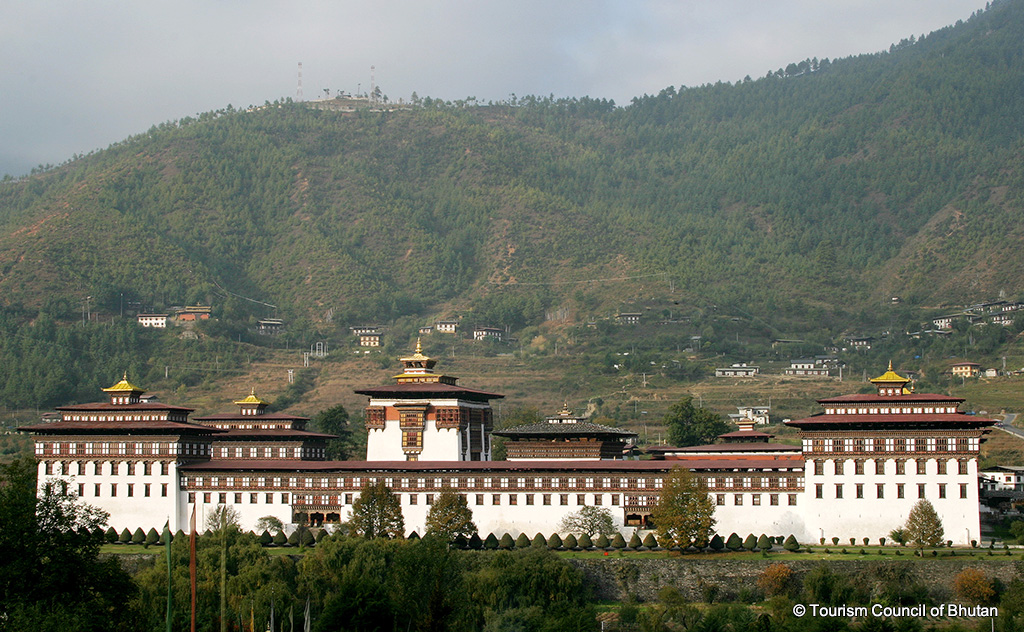
Tashichho Dzong (Fortress)
Tashichho Dzong stands on the left side of the Thimphu/Wang chhu.
In 1641 Zhabdrung built the Tashicho Dzong (Fortress of the auspicious religion) in place of the Dho Ngon (Blue stone) Dzong built by Lama Gyalwa Lhanangpa. In 1698, the dzong caught fire and was restored. The dzong caught fire for a second time during the reign of the 16th Desi and 13th Je Khenpo. In 1869, the dzong once again caught fire. His Majesty the Second King initiated the renovation of the Dzong in 1962. Today, Trashichho dzong houses the secretariat, throne room, and offices of the King of Bhutan. The northern portion is the Je Khenpo and Central Monk Body’s residence.phobjikh
4. Paro Rinpung Dzong


In the 15th century local people offered the crag of Hungrel at Paro to Lama Drung Drung Gyal, a descendant of Pajo Drugom Zhigpo. Drung Drung Gyal built a small temple there and later a five storied Dzong or fortress which was known as Hungrel Dzong.[1]
In the 17th century, his descendants, the lords of Hungrel, offered this fortress to the Drukpa hierarch, Ngawang Namgyal, the Zhabdrung Rinpoche, in recognition of his religious and temporal authority. In 1644 the Zhabdrung dismantled the existing dzong and laid the foundations of a new dzong.[2] In 1646 the dzong was reconsecrated and established as the administrative and monastic centre of the western region and it became known as "Rinpung Dzong".[3]
Some scenes in the 1993 film Little Buddha were filmed in this dzong.
.
5) Gangtey Valley in winter:

The valley of Gangtey is one of the most stunning valleys in the Himalayas, and many call it the Shangri-La of Bhutan, just as how Bhutan is well known for being “one of the world’s happiest nations,” and “the last Shangri-La on Earth.” The surprise of finding such a wide, flat valley without any trees after the hard climb through dense forests is augmented by an impression of vast space, which is an extremely rare experience in Bhutan as most of the valleys are tightly enclosed. This moderate trek visits the villages of Gogona and Khotokha, passing through meadows and fields, then forests of juniper, magnolia and rhododendrons, which will be in full bloom in April. Besides the attractive scenic valley and mountain trails passing through the magnificent forest with its undergrowth changing from rhododendron and magnolia to ferns and dwarf bamboo, we can also visit the historical Gangtey monastery and the blacked necked crane information centre. Additionally, there will be a special treat for those visiting the Gangtey during the winter season, as they will be able to catch the graceful Black-necked Cranes in action as they head to the roost.


Comments
Post a Comment